Work

What I've built, and what it took to build it.

Three longer case studies, plus a handful of smaller projects. I tried to write these the way I'd want to read them: what the problem actually was, what I did about it, and what happened.

2025

Amgen

Graduate Research Fellow, Advanced Modeling and Simulation (Process Development: Transformative Digital Capabilities)

Problem

Process characterization (PC) studies prove that a biologics manufacturing process is robust before it goes to commercial scale. They're also expensive: a standard design can run 75 to 90 bioreactor experiments per study, and Amgen's biologics pipeline was growing faster than lab and workforce capacity could scale to match. The question behind my thesis was simple to state and hard to answer: could a model that already understands some of the underlying biology need meaningfully less data than one that starts from nothing?

Approach

I built hybrid mechanistic and machine learning models using AMGEN's DataHowLab (DHL) platform, which combines a mechanistic simulation backbone with a learned correction layer trained on time-series bioreactor data (pH, temperature, VCD, and other conditions) rather than idealized setpoints. To run this at scale I wrote a modular Python framework: a dedicated API layer that abstracted DHL's client for project discovery, dataset lookup, and model execution, separating low-level platform interactions from the higher-level experimental logic so I could sweep training-set sizes and sampling strategies programmatically instead of clicking through a GUI hundreds of times. The team worked in an agile cadence, three standups a week plus ad hoc pairing sessions, and I held every function I wrote to full unit test coverage, which mattered more than usual given how easily silent data errors can propagate through a modeling pipeline.

On the experimental design side, I benchmarked the hybrid models against Amgen's standard JMP regression approach across eight product quality attributes (PQAs), compared multiple training-subset selection strategies (D-optimal, Sobol, random, and exterior-plus-D-optimal designs), and tested whether augmenting a small set of PC experiments with 24 upstream commercial process development (CPD) runs as a prior improved sample efficiency. I also ran a training-data sufficiency study to find the point of diminishing returns.

Findings

Models trained on roughly 35 PC experiments, augmented with the 24 CPD experiments as a prior, matched or exceeded JMP accuracy for the best-performing PQAs, a 54 percent reduction relative to the 75-run design analyzed and a 61 percent reduction relative to a standard 90-run campaign. Learning curves flattened around 35 to 45 experiments on average, though convergence varied by attribute. A few findings surprised me: measured time-series inputs consistently outperformed idealized setpoint perturbations, space-filling sampling strategies beat boundary-focused designs, and a shared mechanistic backbone across all eight PQAs outperformed attribute-specific tuning, meaning the architecture mattered more than the fine-tuning.
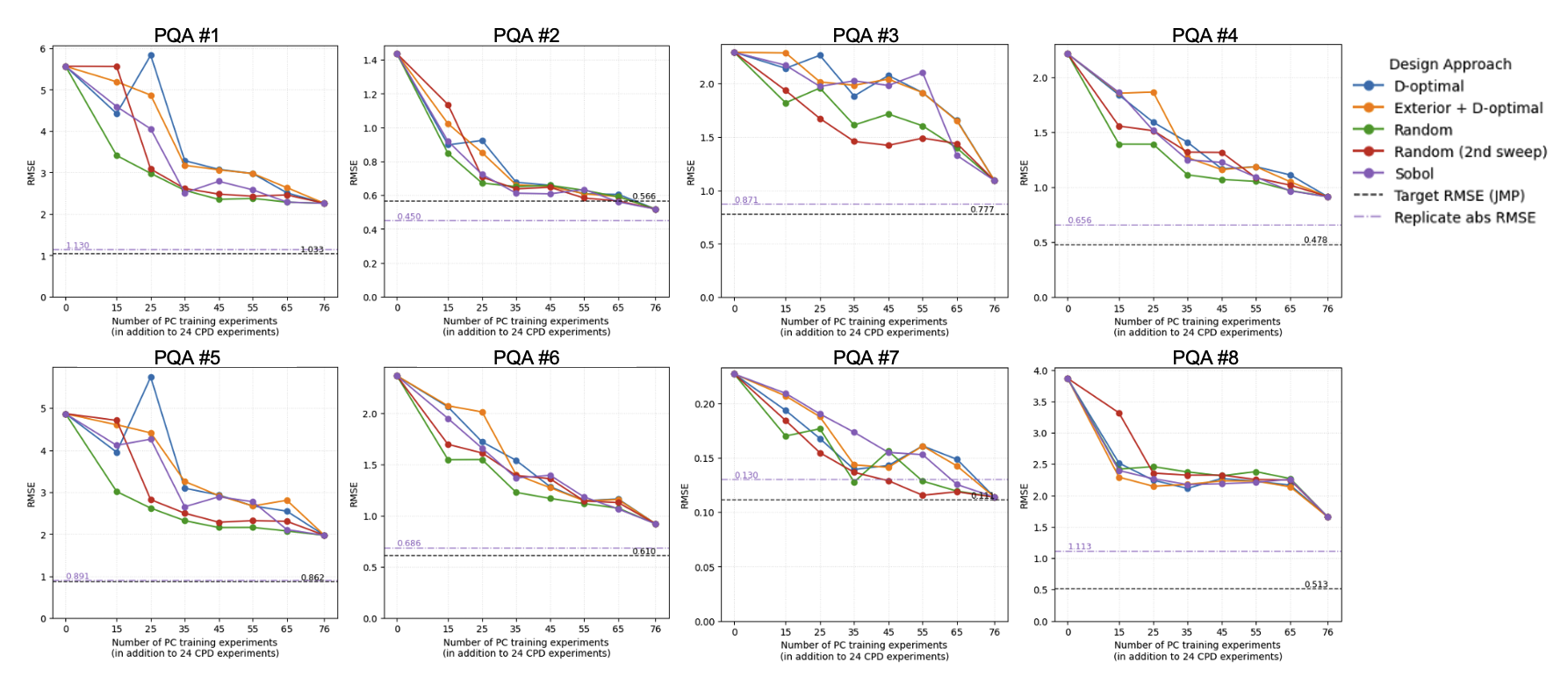
Figure · Thesis, Ch. 4
Learning curves showing RMSE versus number of PC training experiments for each of eight product quality attributes, compared against a JMP regression target and replicate error

RMSE versus training-set size across five subset-selection strategies, for each of eight product quality attributes. Most curves cross the JMP target well before all 76 available experiments are used, which is the empirical basis for the 54 percent reduction.

54%fewer experiments for equivalent accuracy
$725K+annual site-level savings, quantified
~25%faster study cycle times
$15Mper-molecule time-to-market value
Business impact

Beyond the accuracy numbers, I built a transparent, parameterized economic model to translate experimental reduction into operational terms: fewer runs per study compresses execution timelines, accelerates CMC milestones, and frees bioreactor and labor capacity to absorb additional studies without proportional headcount growth. I also designed the change-management and adoption roadmap for rolling the tooling out across Amgen's global network, aligning scientists, managers, and quality and regulatory stakeholders on a phased implementation plan, since a model nobody trusts or knows when to use doesn't save anyone anything.

Hybrid mechanistic ML Python DataHowLab Experimental design Process characterization Change management
2020 to 2024

Deloitte

Consultant (promoted from Business Technology Analyst, 2023), Cell and Gene Therapy Practice

Problem

Most of my clients were healthcare and life sciences organizations trying to translate scientific or strategic promise into something operationally real: a commercial launch plan, a new business unit, an operating model that could actually run. The gap between a good strategy slide and an organization that can execute it is where most of my four years there were spent.

Approach

The work spanned healthcare strategy, digital health platform design, and cell and gene therapy commercialization, with a few adjacent engagements in supply chain risk and technology due diligence along the way. A few representative projects:

Digital health platform for a $71B federal contract

Built the strategy and business case for a large health plan client's digital health platform, and designed the organizational structure and agile operating model for the digital business unit that helped the client secure a $71B federal care delivery contract.

Growth strategy for a PE-backed health-tech platform

Supported the board materials, revised operating model, and new financial model behind a platform business strategy that helped a private equity-backed health-technology client grow from $238M to $1B in revenue over five years.

Five-year commercial launch plan, CAR-T pipeline

Ran stakeholder and expert interviews, market and secondary research to build a detailed five-year commercial launch plan for a mid-sized CAR-T pharmaceutical client, covering everything needed to commercialize its future pipeline of cell therapy assets.

Rare-earth supply chain risk assessment, Department of Defense

Led a risk assessment of US-based rare-earth element and critical mineral supply chains, identifying seven recyclable mine-waste feedstocks, ten feasible bio-based separation techniques, and $1.2B in available federal funding for future investment. Less biotech, more a reminder that operations problems rhyme across industries.

Building the practice

Alongside client work, I helped grow Deloitte's Cell and Gene Therapy practice from $100M to $250M in annual revenue, coordinating strategy with 35 practice leaders and leading a project team of six through executive strategy sessions. I also started Deloitte's Synthetic Biology Food-Technology Industry Working Group from scratch, which grew to 30-plus members across 15 organizations, and ran a monthly onboarding series that helped new hires build community, something I wish had existed when I started.

Healthcare strategy Digital health Cell & gene therapy Technology due diligence Commercial strategy Operating model design
2024 to 2026

MIT Leaders for Global Operations

MBA, MIT Sloan School of Management + SM, Chemical Engineering, MIT School of Engineering

Why LGO

After three years at Deloitte I wanted to go deeper technically without giving up the strategy and operating instincts I'd built. LGO is a dual degree built specifically for that trade: an MBA from Sloan and a Master's in Chemical Engineering, earned together over two years rather than sequentially, anchored by a six-month internship embedded inside a partner company's actual operations instead of a summer project on the side. That structure, engineering and management trained in parallel and stress-tested against a real operating environment, is what made it the right program instead of a standard one-year MBA.

Interdisciplinary training

Coursework spanned both halves of the degree: Advances in Biomanufacturing, Design Principles in Mammalian Systems and Synthetic Biology, and Chemical Reaction Engineering on the technical side; Competitive Strategy, Global Supply Chain Management, and Operations Strategy on the management side; plus courses built to sit at the intersection, like AI and Machine Learning in Molecular Engineering and Cell Biology. The LGO cohort itself, around 45 people, was almost entirely engineers and scientists who had also spent time in operating or strategy roles, which made most classroom discussions feel closer to a working session than a lecture.

Leadership and operations

I chaired the LGO Seminar, sat on the LGO Internship Committee, and, somewhat unexpectedly, was elected president of the Sloan Golf Club, which mostly meant continuing to organize events I'd have wanted to attend anyway. The six-month internship requirement is where the manufacturing and operations training got tested directly: mine was the process characterization work at Amgen, detailed above, which became both my thesis and a live business case.

Dual degree, MBA + SM Operations leadership Manufacturing Biomanufacturing

Other projects

Late 2025

Inspek

MBA Consultant, Strategy and Growth · seed-stage bioprocess analytics and hardware startup

Built investor-ready Series A materials, including market landscape and competitive positioning, and a bottom-up go-to-market strategy across biopharma manufacturing and process analytical technology (PAT) applications. Supported the commercial work behind Inspek's first signed enterprise contract, ahead of a planned 2026 fundraise.

Spring 2025

MIT Sloan Action Learning, Operations Lab

MBA Student Consultant · Series A climate-tech startup

Built inventory planning, capital project evaluation, process simulation, and manufacturing shift-scheduling tools for a Series A cleantech venture producing energy-efficient windows, as part of its new-site scale-up plan. Introduced basic business processes and decision frameworks to a team composed entirely of engineers and scientists, so the founders could focus on fundraising and product instead of operating from memory. (Company name withheld under an MIT NDA.)

2025

MIT Sloan Action Learning, Engine Lab

MBA Consultant, Engine Lab

Worked with a series A deep-tech venture building AI-driven autonomous laboratories to accelerate scientific discovery across drug development, materials, and clean energy. Supported early commercial and operating strategy for the team building the platform's experimentation engine. (Company name withheld under an MIT NDA.)

2019 to 2021

Northwestern University

Research Assistant, Richards Soft Matter and Colloid Laboratory

Designed, built, and ran experiments on the conductive properties of metallic nanoparticle suspensions, including developing a conductive rheometer to test suspension behavior under an applied electric current, in pursuit of applications in water purification and battery technology. Co-authored the resulting paper, published in the Proceedings of the National Academy of Sciences. More on the Writing page.

Skills Python R MATLAB Java C/C++ Salesforce Mandarin (proficient)