Amgen
Graduate Research Fellow, Advanced Modeling and Simulation (Process Development: Transformative Digital Capabilities)
Process characterization (PC) studies prove that a biologics manufacturing process is robust before it goes to commercial scale. They're also expensive: a standard design can run 75 to 90 bioreactor experiments per study, and Amgen's biologics pipeline was growing faster than lab and workforce capacity could scale to match. The question behind my thesis was simple to state and hard to answer: could a model that already understands some of the underlying biology need meaningfully less data than one that starts from nothing?
I built hybrid mechanistic and machine learning models using AMGEN's DataHowLab (DHL) platform, which combines a mechanistic simulation backbone with a learned correction layer trained on time-series bioreactor data (pH, temperature, VCD, and other conditions) rather than idealized setpoints. To run this at scale I wrote a modular Python framework: a dedicated API layer that abstracted DHL's client for project discovery, dataset lookup, and model execution, separating low-level platform interactions from the higher-level experimental logic so I could sweep training-set sizes and sampling strategies programmatically instead of clicking through a GUI hundreds of times. The team worked in an agile cadence, three standups a week plus ad hoc pairing sessions, and I held every function I wrote to full unit test coverage, which mattered more than usual given how easily silent data errors can propagate through a modeling pipeline.
On the experimental design side, I benchmarked the hybrid models against Amgen's standard JMP regression approach across eight product quality attributes (PQAs), compared multiple training-subset selection strategies (D-optimal, Sobol, random, and exterior-plus-D-optimal designs), and tested whether augmenting a small set of PC experiments with 24 upstream commercial process development (CPD) runs as a prior improved sample efficiency. I also ran a training-data sufficiency study to find the point of diminishing returns.
Models trained on roughly 35 PC experiments, augmented with the 24 CPD experiments as a prior, matched or exceeded JMP accuracy for the best-performing PQAs, a 54 percent reduction relative to the 75-run design analyzed and a 61 percent reduction relative to a standard 90-run campaign. Learning curves flattened around 35 to 45 experiments on average, though convergence varied by attribute. A few findings surprised me: measured time-series inputs consistently outperformed idealized setpoint perturbations, space-filling sampling strategies beat boundary-focused designs, and a shared mechanistic backbone across all eight PQAs outperformed attribute-specific tuning, meaning the architecture mattered more than the fine-tuning.
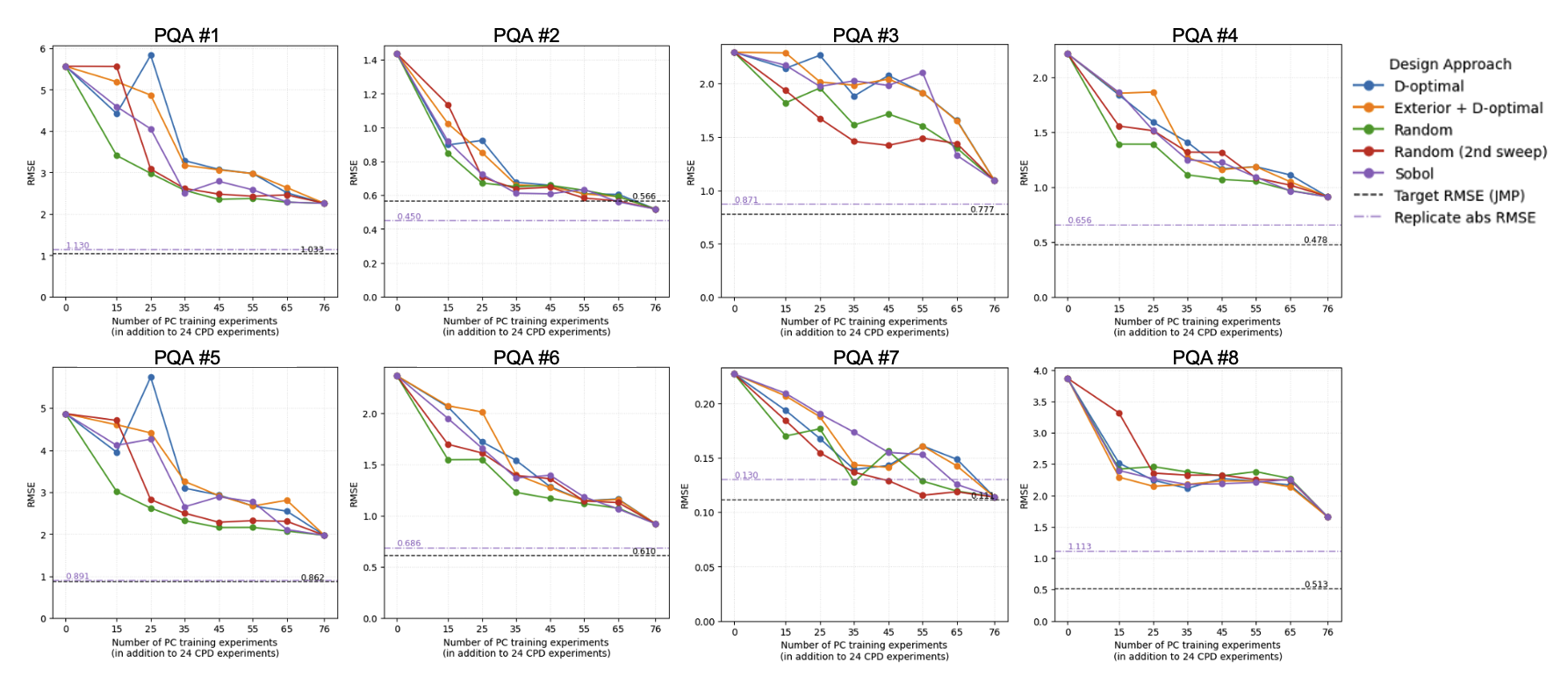
RMSE versus training-set size across five subset-selection strategies, for each of eight product quality attributes. Most curves cross the JMP target well before all 76 available experiments are used, which is the empirical basis for the 54 percent reduction.
Beyond the accuracy numbers, I built a transparent, parameterized economic model to translate experimental reduction into operational terms: fewer runs per study compresses execution timelines, accelerates CMC milestones, and frees bioreactor and labor capacity to absorb additional studies without proportional headcount growth. I also designed the change-management and adoption roadmap for rolling the tooling out across Amgen's global network, aligning scientists, managers, and quality and regulatory stakeholders on a phased implementation plan, since a model nobody trusts or knows when to use doesn't save anyone anything.